Green Tea Swizzle
Strong green tea, pineapple, lime, ginger and mint, swizzled with crushed ice until the glass frosts — herbal and long.
- Difficulty
- medium
- Prep time
- 5 min
- Strength
- Alcohol-free
- Glassware
- Collins glass
- Base
- alcohol free
- Serves
- 1
Related drinks
Ingredients
- Strong green tea, cooled75ml
Brewed at double strength for three minutes, then cooled
- Pineapple juice40ml
- Fresh lime juice20ml
- Ginger syrup15ml
- Fresh mint leaves6 leaves
Plus a sprig for garnish
Garnish: Mint sprig, Freshly grated nutmeg
Method
- Brew the tea: one teabag or 2g of loose green tea in 100ml of water at about 80°C for three minutes, then strain and cool completely.
- Drop the mint leaves into a Collins glass and press them gently once with a bar spoon.
- Add the tea, pineapple juice, lime juice and ginger syrup.
- Fill the glass two-thirds with crushed ice.
- Swizzle: hold a bar spoon or swizzle stick between your palms and spin it while moving it up and down through the ice, until the outside of the glass frosts.
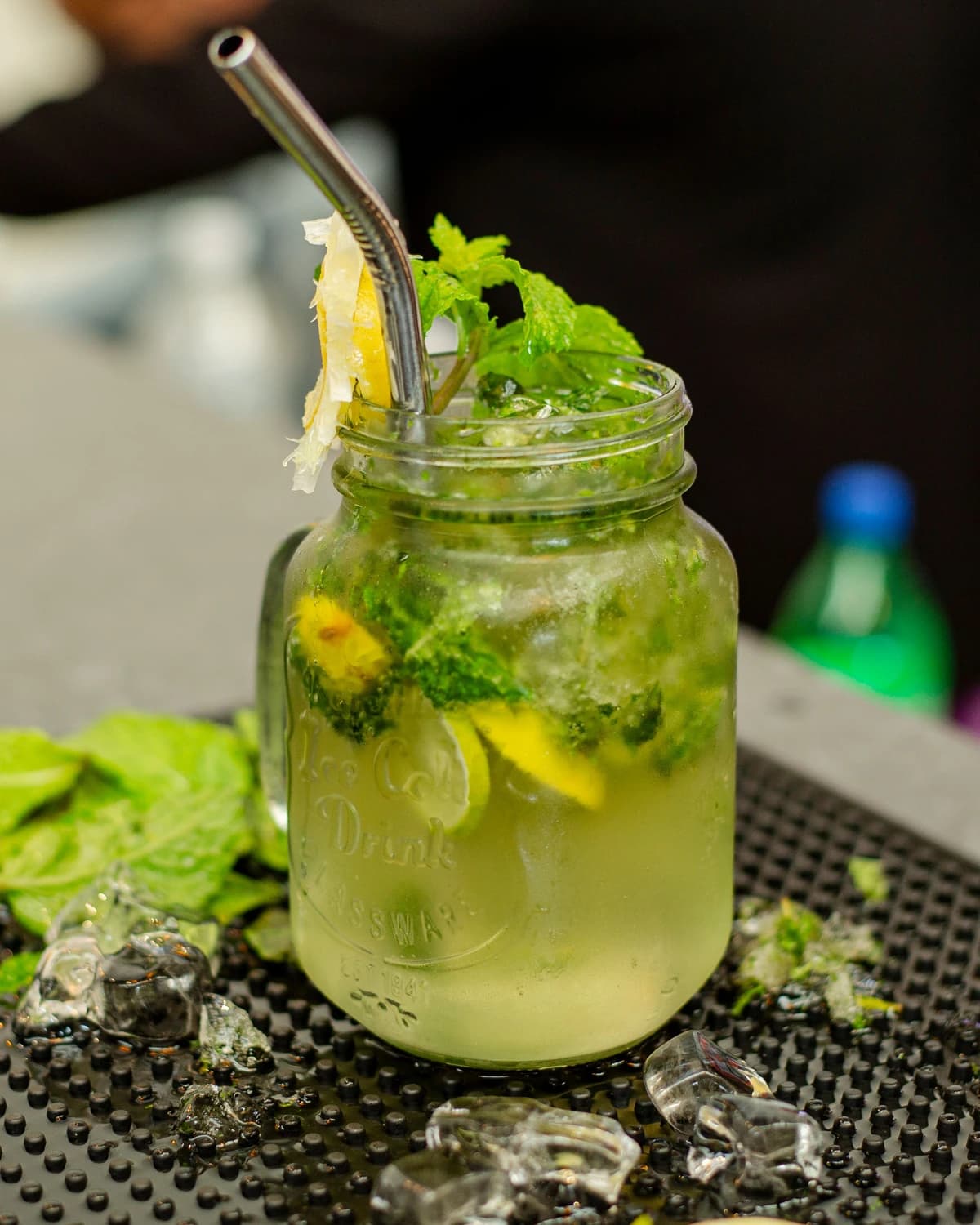
- Top with more crushed ice to a mound, slap the mint sprig between your hands and set it beside the straw, and grate a little nutmeg over the top.
Allergen information
None of this recipe's ingredients, as commonly made, is associated with the fourteen major allergens.
Products vary, and this describes ingredients rather than the bottles you use — check every label. It is not a guarantee that a drink is suitable for anyone with an allergy. How this is worked out
Your version
— private notes, kept on this device
Change a measure, note what you changed and why. It stays in this browser — it is not sent to CocktailHQ, not counted by analytics, and not shown to anyone.
Equipment
Don't have everything? Here's what works instead.
Ice crusher / Lewis bag
Household swap: Ice cubes in a clean tea towel, struck with a rolling pin.
Bar spoon
Household swap: A wooden chopstick, spun between your palms.
Glass and ice
Crushed ice, packed and mounded
Crushed ice chills fast and melts fast, so the drink lengthens as you drink it — which is what a julep or a tiki drink is built for.
Cubes would melt slower and leave it stronger and less cold.
About 150ml poured over the ice
The recipe's collins glass is typically 350–450ml.
- Workable:
- rocks glass, highball glass, wine glass
- Unsuitable:
- coupe glass, nick & nora glass, martini glass, champagne flute
Needs a glass of about 250–300ml brimful.
How this is worked out
- A drink with no ice needs a little of the glass left empty — about a tenth — so it can be carried without spilling and has room for aroma.
- Filled to the top with cubes or packed crushed ice, roughly half to three-fifths of a glass is left for the drink.
- A drink built in the glass dilutes from the ice already there, so its melt water is not added on top.
- One large cube takes up roughly 65–125ml, from a sphere to a 5cm cube.
- Glass capacities are brimful and vary by maker — your own glass, measured with water, is the figure to trust.
Missing an ingredient?
Each swap below says what it changes and how to correct for it, so you can decide whether you are making this drink or a neighbouring one.
Instead of Ginger Syrup
Best substitute: Honey Syrup
This is the sweet element in this drink.
Flavour impact: Softer and floral, without the warmth.
What changes
Expect more sweetness, less acidity and less intensity. Still a good drink, and a slightly different one.
- Sweetness ↑
- The drink will land sweeter, which also makes it read as less sharp and slightly heavier even though nothing else changed.
- Acidity ↓
- Less acidity is the change people notice most and diagnose least — the drink goes flat and slightly cloying rather than obviously wrong.
- Intensity ↓
- A milder ingredient gets buried by whatever else is in the glass, and the drink loses the thing it was named for.
- Character
- Both are sweet, and you lose spicy and warm, and you gain floral, earthy and rich. Numbers can't see this: two ingredients can be identically sour and still smell nothing alike.
To correct for it
- Cut the syrup or sugar back — start by halving it and taste before adding any back.
- Add a little more of it, or a squeeze of fresh citrus, until the drink lifts again.
- Increase the measure, or accept a gentler drink and reduce the components competing with it.
Moderate confidenceShifts the drinkInstead of Green Tea
Best substitute: Black Tea, Strong-Brewed
This is the base in this drink.
Quantity: Brew at normal strength, not double
Flavour impact: Darker and more tannic; less herbal.
What changes
Expect more bitterness and more intensity. Still a good drink, and a slightly different one.
- Bitterness ↑
- Bitterness builds across a drink rather than announcing itself, so this will read as a longer, drier finish.
- Intensity ↑
- A more intensely flavoured ingredient will start to dominate the components around it.
- Character
- you lose grassy, light, refreshing and mildly bitter, and you gain tannic, drying, malty and smoky (lapsang). Numbers can't see this: two ingredients can be identically sour and still smell nothing alike.
To correct for it
- Pour slightly less, or lengthen the drink a little, and let the sweetness catch up.
- Scale it back by a third and let the other ingredients hold their share.
Moderate confidenceShifts the drink
Want to change something these swaps do not cover — too sweet, too thin, a herb you dislike? How to adjust any mocktail works by what each component does rather than by ingredient name.
Make it better
- Brew green tea below boiling. Boiling water pulls out bitterness quickly and the drink turns harsh.
- Swizzling is what makes it cold enough; stirring with a spoon will not frost the glass.
- Serve it promptly. Crushed ice keeps diluting, which suits it for ten minutes, not for half an hour.
- Use freshly squeezed citrus juice rather than bottled — the aromatic oils fade fast once juiced, so squeeze just before making the drink.
Rescue this drink
- Tastes of fruit punch
- The tea was too weak. Brew it at double strength so its bitterness leads.
- Harsh or bitter
- The tea was brewed too hot or too long. Use water off the boil and stop at three minutes.
- Not cold enough
- Not enough swizzling or too little ice. Swizzle until the glass frosts, then mound more ice on top.
- It separates in the glassgeneral guidance
- A built drink with several ingredients relies on the pour to mix it, and denser components — syrups, purées, juice concentrates — sink. Give it one full stir from the bottom up with a bar spoon before garnishing. If it separates again while standing, it wants building over more ice rather than more stirring.
- Served too warmgeneral guidance
- Chill the glass, ice and every ingredient ahead of time — a warm pour is the fastest way to lose a cold drink's balance. For one serving, there's no real fix beyond rebuilding it properly chilled; for a batch, keep everything refrigerated until the moment of serving and add ice last.
Make ahead & storage
Make to order
Make this one to order — it is built on crushed ice, which cannot be prepared ahead. You can still measure and group the ingredients in advance, which is most of the work.
- Fresh lime juice:
- Fresh citrus loses its aroma within hours and turns dull. Squeeze it on the day.
- Fresh mint leaves:
- Fresh herbs and cut fruit darken and turn bitter sitting in a bottle. Muddle or add them per drink, or per small round.
What it tastes like
The taste, and what drives it
off-dry, sharp, very light — a sour-structured drink served over crushed ice.
Off-dry
Dry → Sweet
Sweetened enough to take the edge off without reading as a sweet drink.
What drives it: Ginger syrup — carries the most sugar into the glass. Worked out partly from ingredient category rather than from recorded detail.
Sharp
Soft → Sharp
Properly sharp. This is the axis the drink is built on.
What drives it: Fresh lime juice — supplies the acidity. Worked out partly from ingredient category rather than from recorded detail.
Faintly bitter
Gentle → Bitter
A bitter edge you would only notice if you looked for it.
What drives it: Strong green tea, cooled — provides the bitterness. Worked out partly from ingredient category rather than from recorded detail.
Very light
Light → Rich
Almost weightless in the mouth — closer to a long soft drink than to a sipper.
What drives it: Pineapple juice — adds most of the weight. Worked out partly from ingredient category rather than from recorded detail.
Delicate
Delicate → Bold
Delicate. Rewards attention rather than demanding it.
What drives it: Strong green tea, cooled — is the most concentrated thing in the glass. Worked out partly from ingredient category rather than from recorded detail.
What you smell first
- MintLeadsBefore the first sip
From Fresh mint leaves, Mint sprig
- Baking spiceLeadsBefore the first sip
From Freshly grated nutmeg
- Citrus peel
From Fresh lime juice
- Tropical fruit
From Pineapple juice
- Ginger
From Ginger syrup
Aromas marked as sitting above the drink reach you before the first sip — skipping that garnish changes the drink more than its size suggests.
How it was worked out
Each reading comes from the recipe's own recorded taste scores combined with what each ingredient contributes, weighted by how much of it is in the glass. About 50% of this drink by volume has detailed ingredient data behind it; the rest falls back to broader category rules.
How balance actually works →If it isn't right
What goes wrong with this drink, and why
Only the faults this particular recipe is actually prone to — open one for the likely cause, the adjustment, and what the adjustment costs you.
It's too sweet
- Likely cause
- Ginger syrup is carrying the sugar here, and it is the easiest thing in the drink to over-pour — syrup clings to a jigger and a "splash" is rarely the same twice.
- What to change
- Cut ginger syrup by about a third and rebuild. If it is already made, a squeeze of citrus is faster than starting again.
- What that does
- The drink will read sharper as well as less sweet, because the acid stops being balanced.
- The trade-off
- That is usually the intention, but it is a bigger change than it sounds — overshoot and the drink tips into sour.
It's too sour
- Likely cause
- Fresh lime juice varies more than any other ingredient in the drink. Limes differ by weeks of ripeness, and a sharp one can be half again as acidic as a mild one at the same measure.
- What to change
- Add sweetener a few millilitres at a time rather than diluting — you are correcting a ratio, not a concentration.
- What that does
- Sourness recedes and the drink gains a little weight.
- The trade-off
- Overshoot and you will be reading the too-sweet entry instead. Small additions, tasting between each, are slower but cheaper than a rebuild.
It tastes weak
- Likely cause
- With no alcohol to carry flavour and no heat to cut through, an alcohol-free drink has to work harder for the same presence — thinness here is almost never a measuring error.
- What to change
- Add acidity or bitterness rather than more fruit. Sweetness is what is usually already too high in a thin mocktail.
- What that does
- The drink gains definition without gaining sugar.
- The trade-off
- It will also read as slightly sharper, which is what 'more presence' usually means in practice — not everyone wants that.
It doesn't smell of anything
- Likely cause
- The aroma you are missing is probably mint and baking spice, which sits above the drink rather than in it — skipping or under-expressing the garnish removes it entirely.
- What to change
- Express the peel over the surface with the skin facing the drink, then drop it in. Herbs go in the glass, not on the side.
- What that does
- Aroma arrives before flavour does, so the whole drink reads as more intense without a single measure changing.
- The trade-off
- The oil does land in the drink, though — an over-expressed peel adds a faint bitterness to the first mouthful.
It tastes like juice
- Likely cause
- Alcohol does three jobs in a cocktail besides being alcohol: it adds a slight bitterness, a sense of weight, and a warmth at the back of the throat. Take it away and nothing in this recipe replaces those, so fruit and sugar are left doing all the talking.
- What to change
- Pull the sweetness back a little and add something that pushes against the fruit: a dash of alcohol-free bitters, a strong cold tea for tannin, a pinch of salt, or a thin slice of fresh ginger for heat.
- What that does
- The drink reads as built rather than poured — drier, with an edge that makes you sip rather than gulp.
- The trade-off
- Every one of those additions is an acquired note. Tannin can turn drying, ginger can dominate, and most aromatic bitters contain alcohol — check the label if the drink needs to stay fully alcohol-free.
The herbs taste bitter or grassy
- Likely cause
- Fresh mint leaves gives up its aroma from oils near the leaf surface. Grinding, tearing or shaking it hard breaks into the leaf itself and releases grassy, bitter flavours along with it.
- What to change
- Press fresh mint leaves gently — enough to bruise, not shred — and fine-strain anything shaken with it so no fragments reach the glass. Slap a sprig between your palms for the garnish.
- What that does
- A cleaner, brighter herb character without the bitter, vegetal edge.
- The trade-off
- A gentler press releases less flavour overall, so you may want slightly more leaves to get the same intensity.
The garnish is all I can taste
- Likely cause
- The freshly grated nutmeg sits right under your nose, so it arrives before the drink does. Ground spice is very concentrated, and a heavy grating coats the whole surface.
- What to change
- Grate once or twice, from a height, over half the surface rather than all of it.
- What that does
- The garnish frames the drink rather than replacing it.
- The trade-off
- Too little and the drink loses its first impression — the garnish is doing a real aromatic job here, so ease off rather than leave it out.
The ice melts too quickly
- Likely cause
- Crushed ice has an enormous surface area, so it is meant to melt — but a half-filled glass of it, or ice that was already wet, turns the drink to water in minutes.
- What to change
- Pack the glass to the top and mound more on as it settles. Crush the ice just before serving and keep it in the freezer until then.
- What that does
- The drink stays at its best for longer before the last third goes thin.
- The trade-off
- More ice in the glass means a little less drink fits, and a large cube chills more slowly at first.
The garnish wilts before I serve it
- Likely cause
- Mint sprig loses water at room temperature, so a garnish cut or picked well ahead looks tired by the time a round goes out.
- What to change
- Keep sprigs standing in cold water in the fridge, like cut flowers, and garnish each drink as it is served.
- What that does
- A garnish that looks fresh and still gives off its aroma.
- The trade-off
- Garnishing at the last moment is one more step per drink during service — set the garnishes out in order before guests arrive.
The tea tastes harsh or stewed
- Likely cause
- The tea is brewed for this drink, and tea gives up its tannin faster than its flavour. Green tea brewed with boiling water, or for too long, turns bitter and grassy.
- What to change
- Brew with water at about 80°C for three minutes at most, then take the tea out. For more flavour, use more tea, not more time.
- What that does
- The tea tastes of itself — malty, smoky or grassy — with a grip that dries the finish rather than one that puckers.
- The trade-off
- A shorter brew can taste thin once the drink is diluted and the citrus goes in; brewing stronger costs more tea.
Something else wrong? Open this drink in the Recipe Doctor.
Taste profile
- Sweetness
- 2/5
- Sourness
- 3/5
- Bitterness
- 1/5
- Strength
- 0/5
- Fruitiness
- 3/5
- Freshness
- 4/5
- Creaminess
- 0/5
- Smokiness
- 0/5
Nutrition & alcohol
Estimate only- Calories
- 70 kcal
- Sugar
- 16 g
- Carbohydrates
- 17 g
- Alcohol units (UK)
- 0
- US standard drinks
- 0
- ABV
- 0%
- Serving size
- 150 ml
Show calculation assumptions
Source: Calculated from standard measures
Calorie breakdown: ~0 kcal from alcohol, ~70 kcal from sugar and mixers.
Likely range: 53–88 kcal, reflecting the confidence level above — not a lab-measured figure.
Assumes 1:1 ginger syrup, unsweetened pineapple juice at about 12g sugar per 100ml, and unsweetened tea.
These figures are estimates, not laboratory measurements — individual tolerance to alcohol varies. See our responsible drinking guidance.
Variations
Matcha Swizzle
Whisk 1g of matcha into 75ml cold water instead of brewed tea.
What kind of drink this is
The structure behind the recipe
A built build: a sour-structured alcohol-free drink, served over crushed ice — clean in the mouth.
Sour-structured
Something sour and something sweet held in balance over a base — the structure behind the whole sour family and everything descended from it.
Base
Strong green tea, cooled
Modifier
Pineapple juice
Sour element
Fresh lime juice
Sweet element
Ginger syrup
Aromatic
Fresh mint leaves
Drinks built this way are collected as the Tiki family.
Technique
built
Components are poured into the serving glass over ice and stirred once, or not at all. Dilution happens while you drink rather than before.
The drink changes as you go: strongest at the first sip, longest and most diluted at the last. That drift is a feature of a long drink and a fault in a short one.
What it ruins: Nothing, but it cannot properly combine anything viscous — a syrup poured last will sit at the bottom.
Also involves swizzling.
Everything about building in the glass →How the technique works →Dilution
In the glass, as you drink
Water from ice typically makes up around 15% of the finished drink for a built build (commonly 10–20%). Dilution is an ingredient here, not a side effect.
Why dilution is an ingredient →Served
Over crushed ice
Collins glass · 190ml
Crushed ice chills and dilutes faster than cubes and keeps doing both while you drink, which is exactly what a drink built on strong flavours wants.
Texture and aroma
Nothing here thickens or aerates the drink — it is as light in the mouth as the liquid itself.
These components are doing aromatic work: you meet them at the nose before the first sip, and they shape how everything underneath reads.
Where to go from here
Each of these is here because of something specific about this drink, not as a standard set of links.
Drinking this with food: seafood, oysters and anything raw
On its recorded taste scores this drink meets the test for seafood, oysters and anything raw — the page explains the principle behind it rather than simply asserting the pairing.
Making alcohol-free drinks that stand up
Alcohol does structural work in a drink, and this one has to do those jobs another way. The alcohol-free path works through how.
Where it comes from
Origin and family
Origin of the Green Tea Swizzle
A CocktailHQ adaptation of the Chartreuse Swizzle's structure, not a historical drink. Strong green tea and mint stand in for the Chartreuse's herbs, and ginger syrup for the falernum's spice.
Family
TikiTwo or more rums · two or more citrus · an aromatic sweetener (orgeat, falernum) · crushed ice.
On drinks history
Cocktail origin stories are frequently repeated and rarely evidenced. Our history section separates what is documented from what is folklore rather than picking whichever version reads best.
History and culture →Try this next
- Virgin Mojito
You may like this because it shares a refreshing taste profile with the Green Tea Swizzle.
 Cinderella
You may like this because it shares a tropical taste profile with the Green Tea Swizzle.
- Green Tea SourGreen Tea Sour
You may like this because it shares a herbal taste profile with the Green Tea Swizzle.
Questions people ask
- What does swizzling do?
- Spinning a swizzle stick or bar spoon between your palms through crushed ice mixes and chills the drink fast, until the outside of the glass frosts. A stir will not get it that cold.
- Why is my Green Tea Swizzle bitter?
- See the troubleshooting above: green tea brewed with boiling water or for too long turns harsh. Use water at about 80°C and stop at three minutes.
Use up your ingredients
Bought a bottle just for this? Here's what else it's good for.
Related tools
Scale this for a party
Work out bottles, mixers, ice and total alcohol units for any number of guests.
How far a bottle goes
Drinks per bottle, which bottle runs out first, batching — and the cost, at your own prices.
Recipe confidence
The structure is sound; the tea's strength decides the balance, so brew it as written.