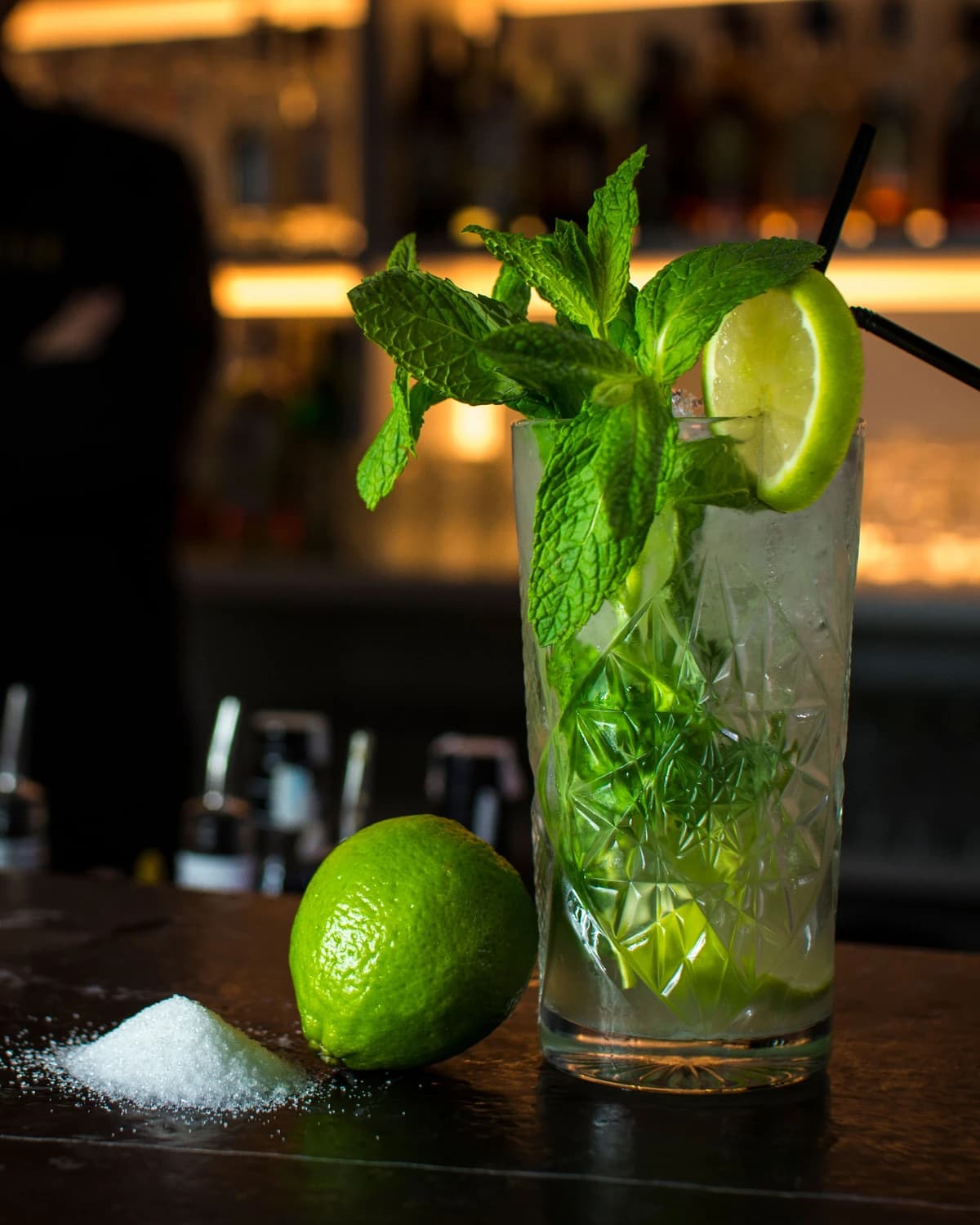
Mojito
A Cuban highball of white rum, lime, mint and soda — bright, herbal and endlessly refreshing.
- Difficulty
- easy
- Prep time
- 5 min
- Strength
- 8.3% ABV
- Glassware
- Highball glass
- Base
- rum
- Serves
- 1
Related drinks
Ingredients
- Fresh mint leaves7ml
About 8–10 leaves, plus a sprig for garnish
- Fresh lime juice30ml
- Simple syrup20ml
- White rum50ml
- Soda water90ml
To top
Garnish: Mint sprig, Lime wheel
Method
- Add mint leaves and lime juice to a highball glass and muddle gently to bruise the mint — don't shred it.
- Add the simple syrup and white rum.
- Fill the glass with cubed ice and stir briefly to combine.
- Top with soda water and stir once more, lifting the mint from the bottom.
- Garnish with a fresh mint sprig and a lime wheel.
Equipment
Don't have everything? Here's what works instead.
Muddler
Household swap: The handle end of a wooden spoon
Press, don't pound.
Jigger
Household swap: A tablespoon measure (1 tbsp ≈ 15ml)
Missing an ingredient?
Each swap below says what it changes and how to correct for it, so you can decide whether you are making this drink or a neighbouring one.
Instead of White Rum
Best substitute: Gold Rum (or Cachaça)
This is the base in this drink.
Quantity: Use the same amount
Flavour impact: Gold rum adds light caramel notes; cachaça makes it closer to a caipirinha-mojito hybrid.
What changes
Expect more sweetness. Still a good drink, and a slightly different one.
- Sweetness ↑
- The drink will land sweeter, which also makes it read as less sharp and slightly heavier even though nothing else changed.
- Character
- you lose clean, light, subtly sweet and sugarcane-forward, and you gain caramel, oaky, medium-bodied and warm. Numbers can't see this: two ingredients can be identically sour and still smell nothing alike.
To correct for it
- Cut the syrup or sugar back — start by halving it and taste before adding any back.
High confidenceBoth are common bar substitutions that preserve the drink's character.Shifts the drinkInstead of White Rum
Best substitute: Alcohol-Free Spirit
This is the base in this drink.
Flavour impact: Produces a Virgin Mojito — the mint and lime carry the drink, with less body and warmth.
What changes
Expect less sweetness, more bitterness and less intensity. Still a good drink, and a slightly different one.
- Sweetness ↓
- Less sweetness leaves the acid and the spirit more exposed, so the drink will taste sharper and drier than it should.
- Bitterness ↑
- Bitterness builds across a drink rather than announcing itself, so this will read as a longer, drier finish.
- Intensity ↓
- A milder ingredient gets buried by whatever else is in the glass, and the drink loses the thing it was named for.
- Character
- you lose clean, light, subtly sweet and sugarcane-forward, and you gain botanical, varies by style and light-bodied. Numbers can't see this: two ingredients can be identically sour and still smell nothing alike.
To correct for it
- Add a little more syrup, a small amount at a time, until the edges come back together.
- Pour slightly less, or lengthen the drink a little, and let the sweetness catch up.
- Increase the measure, or accept a gentler drink and reduce the components competing with it.
High confidenceThis is the standard alcohol-free version of the drink, not an approximation.Shifts the drinkBecomes a variation
Make it better
- Slap the mint sprig between your hands before garnishing to release its aroma without bruising it.
- Use fresh lime juice — bottled juice loses the aromatic oils that give a mojito its lift.
- Muddle gently; over-crushing mint releases chlorophyll and turns the drink bitter.
- Add the carbonated mixer last, after shaking or stirring the rest, and pour gently to keep as much fizz as possible.
Rescue this drink
- Tastes bitter
- The mint was likely over-muddled. Next time, press gently just until you smell the aroma lift.
- Too sour
- Add 5–10ml more simple syrup and stir.
- Too weak or watery
- You may have over-diluted with ice before adding soda. Use fewer, larger ice cubes and stir less.
- Flat
- Top with soda water again just before serving — it loses fizz quickly once stirred.
- It foams over when the mixer goes ingeneral guidance
- Something in the glass is nucleating the carbonation — usually fresh ice with frost on it, or a sugary residue on the side. Pour the mixer slowly down the inside of the glass onto a spoon rather than onto the ice, and add it last. A drink built the other way round loses most of its fizz before it reaches the table.
- You cannot smell itgeneral guidance
- Most of a drink's aroma is on top of it, not in it. Slap the herb sprig once between your palms before it goes in; it bruises the surface oils without shredding the leaf. Aroma also fades fastest of anything in a drink, so garnish at the moment of serving rather than in advance.
- The garnish is louder than the drinkgeneral guidance
- A garnish is seasoning, and this one carries an aromatic garnish on a drink that is not especially assertive. If it smells more of the garnish than of itself, use less of the aromatic one rather than removing both — whole spices in particular keep giving long after the first sip.
- Too sweetgeneral guidance
- Add a small amount of fresh citrus juice or a dash of bitters to bring the balance back — adjust gradually and taste as you go.
- Served too warmgeneral guidance
- Chill the glass, ice and every ingredient ahead of time — a warm pour is the fastest way to lose a cold drink's balance. For one serving, there's no real fix beyond rebuilding it properly chilled; for a batch, keep everything refrigerated until the moment of serving and add ice last.
- No muddlergeneral guidance
- The handle end of a wooden spoon
- Missing the garnishgeneral guidance
- No mint sprig? A few loose mint leaves scattered on top work if you don't have a full sprig to spare.
Make ahead & storage
Batch the base, finish at serving
Batch the 3 stable components days ahead and add fresh lime juice and soda water when you pour.
- Fresh lime juice:
- Fresh citrus loses its aroma within hours and turns dull. Squeeze it on the day.
- Soda water:
- Carbonated — it goes flat in a bottle, and there is no way to put the fizz back.
What it tastes like
The taste, and what drives it
off-dry, sharp, very light, sparkling — a sour-structured drink served long, over ice.
Off-dry
Dry → Sweet
Sweetened enough to take the edge off without reading as a sweet drink.
What drives it: Simple syrup — carries the most sugar into the glass.
Sharp
Soft → Sharp
Properly sharp. This is the axis the drink is built on.
What drives it: Fresh lime juice — supplies the acidity.
Very light
Light → Rich
Almost weightless in the mouth — closer to a long soft drink than to a sipper.
No single ingredient accounts for this — it comes from the combination rather than from one bottle.
Sparkling
Still → Sparkling
Carbonated, which lifts the aromatics and makes the drink taste drier than its sugar content alone would suggest.
What drives it: Soda water — carries the carbonation.
Moderate
Delicate → Bold
Moderate: assertive enough to hold its own, mild enough for a second.
What drives it: White rum — is the most concentrated thing in the glass.
What you smell first
- MintLeadsBefore the first sip
From Fresh mint leaves, Mint sprig
- Citrus peelLeads
From Fresh lime juice, Lime wheel
- Caramel and molasses
From White rum
Aromas marked as sitting above the drink reach you before the first sip — skipping that garnish changes the drink more than its size suggests.
How it was worked out
Each reading comes from the recipe's own recorded taste scores combined with what each ingredient contributes, weighted by how much of it is in the glass. Almost everything in this drink has detailed ingredient data behind it.
How balance actually works →If it isn't right
What goes wrong with this drink, and why
Only the faults this particular recipe is actually prone to — each with the likely cause, the adjustment, and what the adjustment costs you.
The herbs can be muddled too far
Degrades itPressing releases aromatic oil; shredding releases chlorophyll, which is bitter and grassy. The second is not a stronger version of the first — it is a different flavour.
How to handle it: Press two or three times and stop. If the leaves have gone black and the drink smells of cut grass, it has gone past it.
It's too sweet
- Likely cause
- Simple syrup is carrying the sugar here, and it is the easiest thing in the drink to over-pour — syrup clings to a jigger and a "splash" is rarely the same twice.
- What to change
- Cut simple syrup by about a third and rebuild. If it is already made, a squeeze of citrus is faster than starting again.
- What that does
- The drink will read sharper as well as less sweet, because the acid stops being balanced. That is usually the intention, but it is a bigger change than it sounds.
It's too sour
- Likely cause
- Fresh lime juice varies more than any other ingredient in the drink. Limes differ by weeks of ripeness, and a sharp one can be half again as acidic as a mild one at the same measure.
- What to change
- Add sweetener a few millilitres at a time rather than diluting — you are correcting a ratio, not a concentration.
- What that does
- Sourness recedes and the drink gains a little weight. Overshoot and you will be reading the too-sweet entry above instead.
It tastes weak
- Likely cause
- Usually dilution rather than measurement: muddling adds water as it chills, and wet or small ice adds far more of it than cold, large ice does.
- What to change
- Use larger, colder ice and work faster. Adding more spirit fixes the symptom and unbalances everything else.
- What that does
- The drink gains definition without gaining sugar. It will also read as slightly sharper, which is what 'more presence' usually means in practice.
It's gone flat
- Likely cause
- Soda water loses gas to warmth, to agitation and to anything it can nucleate against — pulp, sugar crystals, a dry glass.
- What to change
- Chill the mixer properly, add it last, pour it against the inside wall of the glass, and stir once at most.
- What that does
- The bubbles last, which also makes the drink taste drier — carbonation contributes a real acidity of its own on top of the lift.
It doesn't smell of anything
- Likely cause
- The aroma you are missing is probably mint, which sits above the drink rather than in it — skipping or under-expressing the garnish removes it entirely.
- What to change
- Express the peel over the surface with the skin facing the drink, then drop it in. Herbs go in the glass, not on the side.
- What that does
- Aroma arrives before flavour does, so the whole drink reads as more intense without a single measure changing. The oil does land in the drink, though — an over-expressed peel adds a faint bitterness to the first mouthful.
Taste profile
- Sweetness
- 2/5
- Sourness
- 3/5
- Bitterness
- 0/5
- Strength
- 2/5
- Fruitiness
- 2/5
- Freshness
- 5/5
- Creaminess
- 0/5
- Smokiness
- 0/5
Nutrition & alcohol
Estimate onlyCalculated from standard measures; garnish and exact syrup sweetness vary by pour.- Calories
- 160 kcal
- Sugar
- 11 g
- Carbohydrates
- 13 g
- Alcohol units (UK)
- 2
- US standard drinks
- 1.12
- ABV
- 8.3%
- Serving size
- 240 ml
Show calculation assumptions
Source: Calculated from standard measures
Calorie breakdown: ~110 kcal from alcohol, ~50 kcal from sugar and mixers.
Likely range: 120–200 kcal, reflecting the confidence level above — not a lab-measured figure.
Based on 50ml white rum at 40% ABV, 20ml simple syrup, and standard citrus dilution.
These figures are estimates, not laboratory measurements — individual tolerance to alcohol varies. See our responsible drinking guidance.
Variations
Prefer it alcohol-free?
Try the Virgin Mojito, built to carry the same flavour without any alcohol.
Strawberry Mojito
Muddle 3–4 strawberry halves with the mint and lime for a fruitier, sweeter take.
Spicy Mojito
Add a slice of fresh chilli to the muddle for a warm kick.
What kind of drink this is
The structure behind the recipe
A muddled build: a sour-structured rum-based drink, served long, over ice — sparkling in the mouth.
Sour-structured
Something sour and something sweet held in balance over a base — the structure behind the whole sour family and everything descended from it.
Base
White rum
Spirit in the largest measure — read as the base.
Sour element
Fresh lime juice
A short, sharp measure — recorded acidity 5/5, and nothing sharper is poured short, so this is the sour element.
Sweet element
Simple syrup
A syrup — its whole job in the drink is to sweeten and to add a little body along with it.
Lengthener
Soda water
A long measure of mixer — this is what makes the drink long.
Aromatic
Fresh mint leaves
Herbs contribute aroma.
Drinks built this way are collected as the Highball family.
5 components' roles areworked out from the ingredient's category and recorded taste attributes rather than set by hand — the reasoning is shown above so you can disagree with it.
Technique
muddled
Pressure ruptures cell walls in fruit or herbs, releasing juice and volatile oils directly into the drink.
Fresh, green, immediate aroma that no syrup or liqueur reproduces, because it has not been heated or preserved.
What it ruins: Herbs, if you keep going. Mint bruised gently gives oil; mint shredded gives chlorophyll, which is bitter and grassy. This is the technique most often overdone.
Everything about muddling →How the technique works →Dilution
During mixing, then strained
Water from ice typically makes up around 20% of the finished drink for a muddled build (commonly 15–25%). Dilution is an ingredient here, not a side effect.
Why dilution is an ingredient →Served
Long, over ice
Highball glass · 240ml
Served on ice, so it keeps chilling in the glass. A larger, colder, slower drink than the same spirits served straight up.
Texture and aroma
Carbonation lifts aromatics and adds a slight acidity of its own, which is why a long drink can taste drier than its sugar content suggests.
These components are doing aromatic work: you meet them at the nose before the first sip, and they shape how everything underneath reads.
Where to go from here
Each of these is here because of something specific about this drink, not as a standard set of links.
Why this drink matters
This one carries 2 independent kinds of the evidence used to identify influential drinks — each with a test you can check rather than a ranking.
Drinking this with food: seafood, oysters and anything raw
On its recorded taste scores this drink meets the test for seafood, oysters and anything raw — the page explains the principle behind it rather than simply asserting the pairing.
Making good drinks at home
A good drink to learn on. The beginner path covers the four things that actually make a home cocktail disappointing.
Where this fits in a home bar
White Rum is bottle 6 in the order that unlocks the most drinks — buying it opens up 4 recipes beyond the ones before it.
Where it comes from
Origin and family
Origin of the Mojito
Cuban, and generally traced to 19th-century Havana, though the drink's ancestry runs further back to El Draque — a rough mix of aguardiente, lime, sugar and mint recorded in the Caribbean from the late 1500s. The name's origin is disputed; it is commonly linked to mojo, the Cuban lime-and-garlic sauce, without a contemporary source establishing it. What is documented is the Bodeguita del Medio's association with the drink from the 1940s, which is where its modern fame begins.
Standard proportions follow modern Cuban and international bar practice; the El Draque connection is widely reported in drinks history rather than established by a single contemporary source.
The wider history
Every claim on these pages is labelled by how well the evidence supports it — documented, disputed, or folklore.
Try this next
- Whiskey Smash
Whiskey Smash
You may like this because it shares a refreshing-forward profile with the Mojito, but uses whisky instead of rum.
- Southside
Southside
You may like this because it shares a refreshing-forward profile with the Mojito, but uses gin instead of rum.
- Gin Basil Smash
Gin Basil Smash
You may like this because it shares a herbal-forward profile with the Mojito, but uses gin instead of rum.
Questions people ask
- Can I make a Mojito without muddling?
- Not really — muddling is what releases the mint's oils and lime's juice together. Pressing gently (not pounding) is part of the method, not an optional step.
- What's the alcohol-free version called?
- Virgin Mojito — the same mint, lime and soda, built without the rum.
- Why does my Mojito taste bitter?
- See "Rescue this drink" above — it's almost always over-muddled mint releasing bitter chlorophyll.
Use up your ingredients
Bought a bottle just for this? Here's what else it's good for.
Related tools
Scale this for a party
Work out bottles, mixers, ice and total alcohol units for any number of guests.
Recipe confidence
Well-documented IBA classic recipe with widely agreed proportions.